
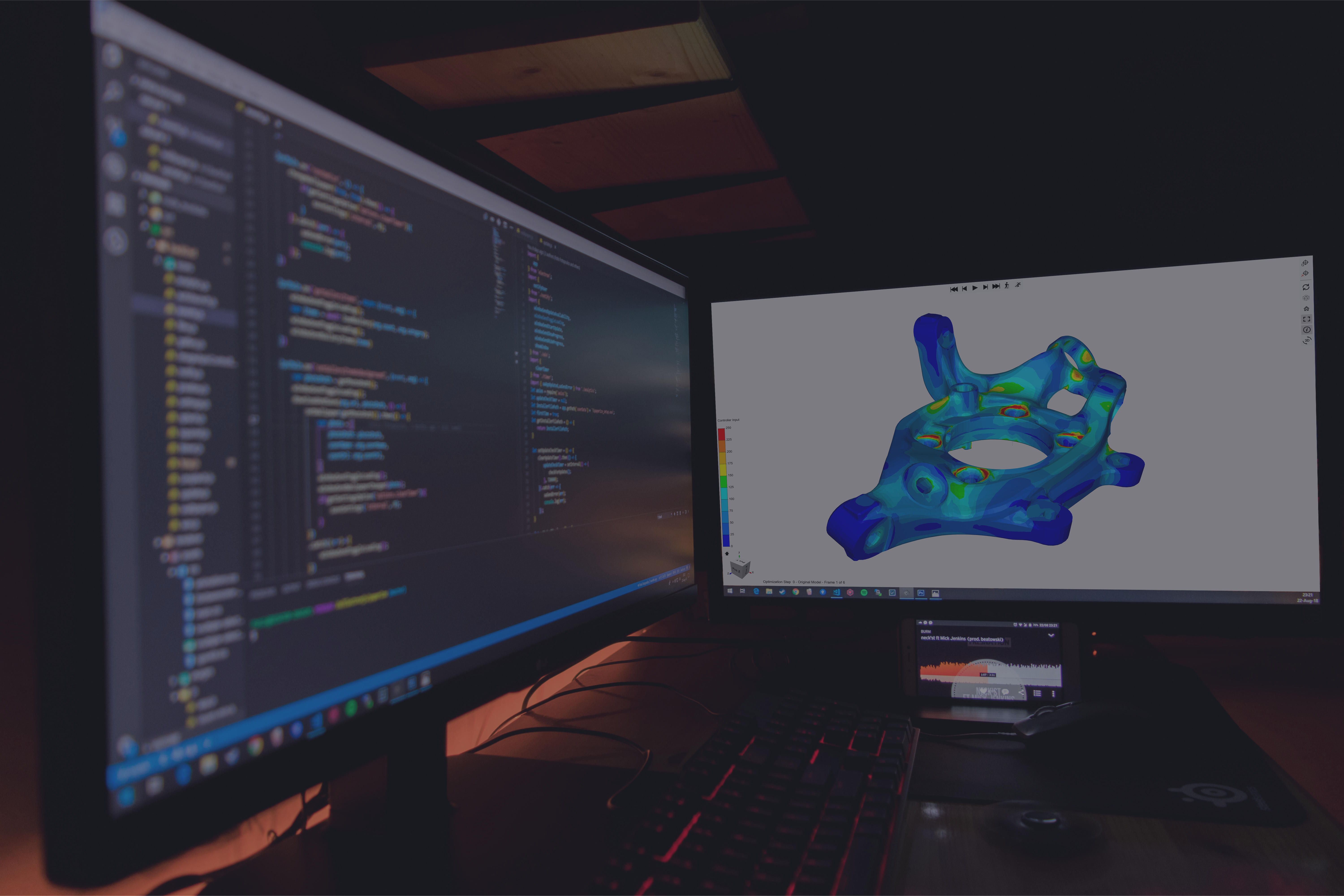
HOOPS SDKs Support nTop in Bringing the Capabilities of Additive Manufacturing to New Markets
nTop & Tech Soft 3D
The Challenge
nTop is a New York based company working to bring high-performance computational design to additive and mainstream manufacturing. From the company’s start in 2015, nTop has been aware of the complex problem engineers faced in taking advantage of these capabilities.

"From a development perspective, we appreciated the level of control working with the [HOOPS] APIs of these components and being able to build out a broad suite of interoperability between the different tools that our customers use alongside nTop.”
Trevor Laughlin, Vice President of Product
The evolution of additive manufacturing presented new opportunities, but the limitations of existing design tools were a problem. “The tools at the time weren't allowing engineers to tap into that design freedom,” Trevor Laughlin, Vice President of Product at nTop explains.
When talking about the intricate challenges designing for additive processes presents, Trevor commented, “Designing that level of complexity in CAD programs at the time was very slow and painful, and in some cases, not even possible.”
nTop’s software is designed to solve these issues by offering a different approach to supporting advanced design. Trevor said, “We develop powerful computational design tools that enable creators to accelerate innovation and deliver products the world needs.”
The three core technology components of nTop’s design approach are implicit modeling, field-driven design, and design automation. Implicit design defines geometry through mathematical equations that Trevor explains, “Give it speed, reliability and all the complexity that it can do from a modeling perspective.”
Field-Driven Design allows users to implement changes to their model without manual input by defining rules. Trevor explained this process, “We built a computational model that says, given these rules, where the deflection is high, put more beams there. The software automatically takes that deflection field as input and will output the geometry according to that model that you set up, automatically without having to manually think about it or model it.”
Finally, design automation is built to create reusable processes, not just individual parts. These workflows are intended to help teams iterate more quickly than previously possible.
nTop’s common applications include lightweighting, thermal and fluid management, mass customization, energy absorption and comfort, and acoustic, vibration, and radio frequency.
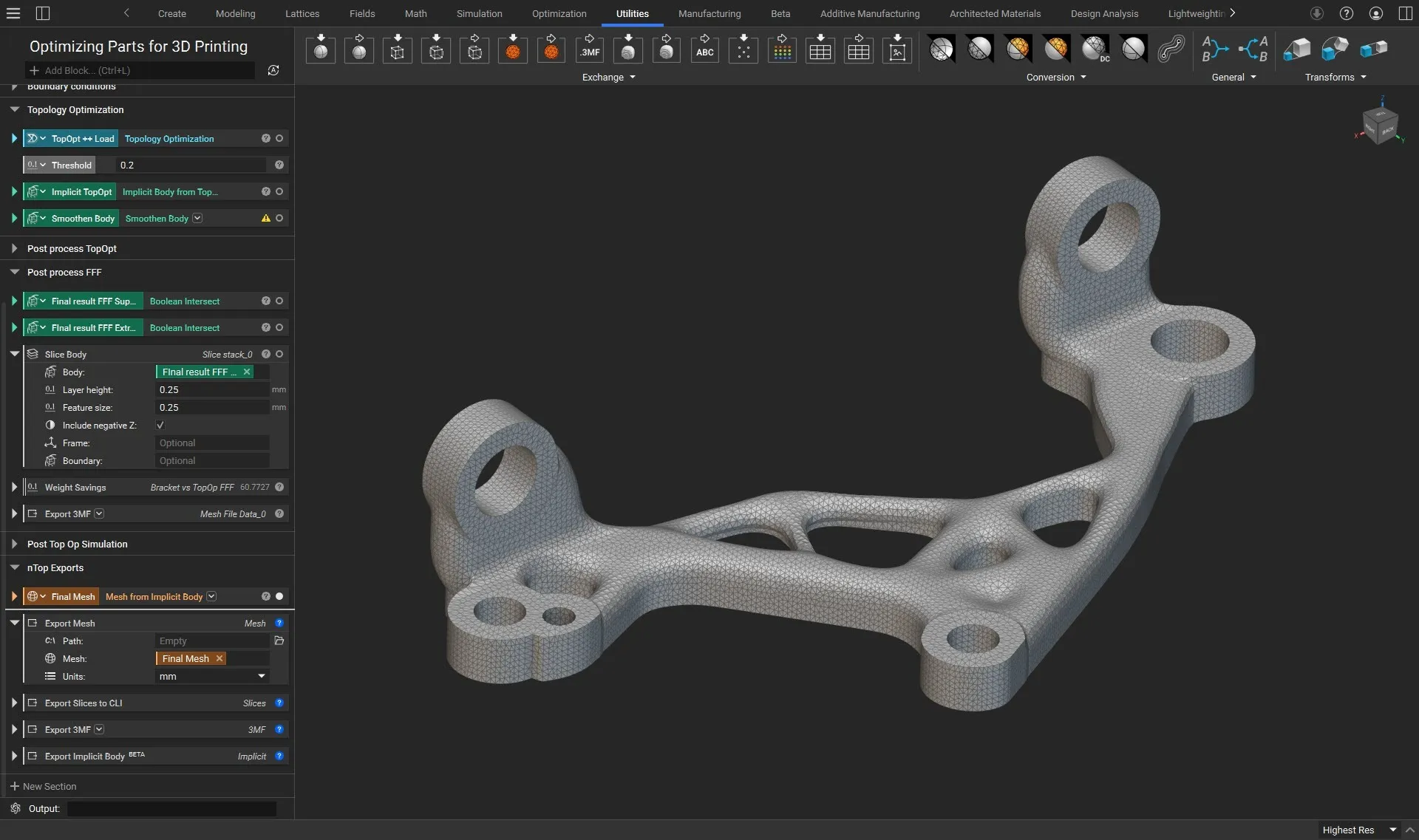
nTop's product in action
CAE Toolkits Help Provide Advanced Additive Manufacturing Capabilities to A Wide Array of Markets
With their goals of improving efficiency and capabilities in additive manufacturing, nTop needed to develop a wide array of powerful CAE functionality into their product. To do this, they leveraged the HOOPS Product line, including HOOPS Mesh, HOOPS Solve, and HOOPS Access.
HOOPS SDKs provide a balance of control and developer-friendly ease of use, which allowed nTop to customize where they needed to without having to start from scratch. “The APIs were very open, and that gave us enough access to very low-level control and allowed us to build our optimization framework on top of it,” Trevor explained.
Trevor summarized how each is used, saying “Integrated structural and thermal FEA capabilities are where the HOOPS Mesh and HOOPS Solve components are used.” Meanwhile, HOOPS ACCESS provides an interoperability framework for the diverse array of tools their customers use.
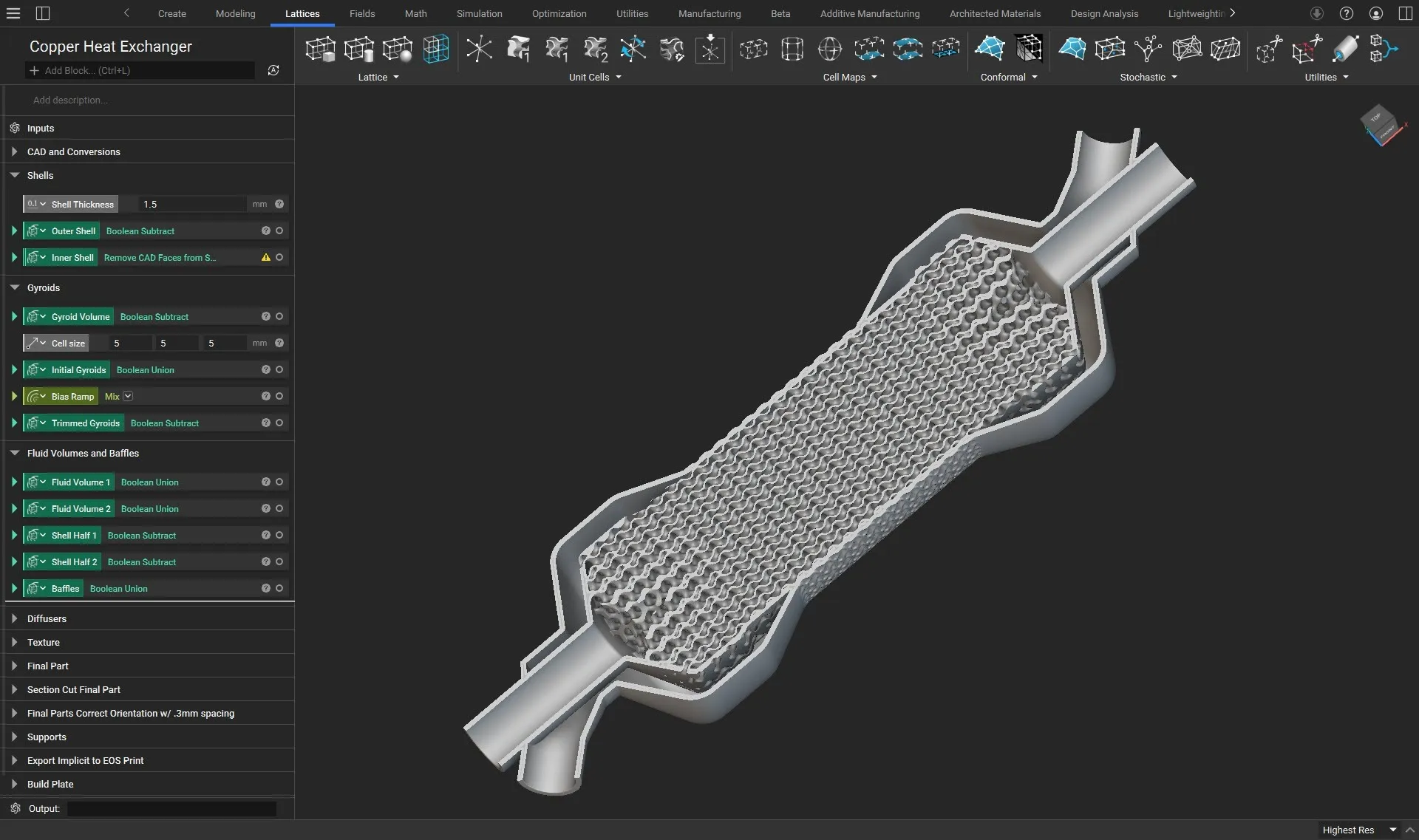
Additionally, HOOPS Solve is a key part of increasing efficiency in the design process. The field optimization capabilities from nTop allow the optimization of shell thickness and boundaries to the manufacturing tolerances. As Trevor explains, “Many of the physics-driven optimization techniques leverage the HOOPS Solve components."
When the simulation stage of the workflow was done elsewhere, HOOPS products enhanced what nTop could provide its customers. “HOOPS Mesh with the pre-processing, and HOOPS ACCESS with the interoperability helped us close the loop and make this interaction possible between nTop and other tools our customers use,” said Trevor.
These customization and interoperability benefits are key for nTop, as Trevor summarized: “From a development perspective, we appreciated the level of control working with the APIs of these components and being able to build out a broad suite of interoperability between the different tools that our customers use alongside nTop.” Tech Soft 3D is a proud partner of nTop, even highlighting them in our recent 2024 Summit. We look forward to continuing to support their goals of improving the accessibility and capability of high-performance engineering design to industries across the world.
Industry:
Additive Manufacturing
Challenge:
Sought to create an improve efficiency and capabilities of design and manufacturing Needed to support a wide array of CAE features
Required a level of customization in their component technology, with simple, open API
Solution:
HOOPS provides a host of CAE capabilities to bolster the additive design use cases of nTop’s customers
Results:
Create a power design platform, with the interoperability and flexibility to support diverse, complex workflows
Focus on the unique value proposition of nTop instead of pouring resources into developing CAE capabilities