Trends in AEC Software Development for 2026
AEC is a rapidly evolving market, and developers must stay on top of these trends to create software that is in touch with their end users' needs. For AEC software developers, understanding these shifts and addressing them can be the difference between creating tools that endure and those that quickly become obsolete.
With that in mind, here are some of the most crucial trends to follow in 2026 and beyond.
Cloud-First Platforms are the Norm
Cloud-based tools have become more of a mainstay in many industries as the technology continuously evolves and improves. After years of their presence growing in AEC applications, “Cloud First” platforms are becoming the norm.
The ever-growing complexity of BIM and scanned models, along with the globalization of projects, both in scope and staff, greatly favors cloud applications. There is more demand than ever from customers to simplify the user experience and streamline collaboration, all while facing enormous pressure to facilitate innovation quickly.
While all these forces are pushing cloud to the forefront, one term is coming up again and again that developers must be aware of: data sovereignty.
Users demand the convenience of cloud applications, without giving up control of their data. AEC application developers must be aware of this balancing act to stay competitive with the products
AI is Moving Beyond the Buzz and Into Reality
No “trends” piece in tech is seemingly complete without updates on the impact of artificial intelligence to the market in question. For AEC, 2026 is a massive year. Similarly to how cloud-first applications are becoming the norm, AI in AEC is moving beyond the buzz and into practical, everyday use.
In our experience with Tech Soft 3D Partners and at relevant trade shows, we are seeing grounded, reliable applications that leverage AI tools go far beyond proof of concepts or simple leveraging of LLMs. These applications are especially present in early-stage design, automation, and data enrichment.
AI technologies are inherently useful for design optimization, allowing teams to explore thousands of possible configurations in a fraction of the time, balance competing priorities such as cost, sustainability, and structural performance, and rapidly converge on solutions that would be difficult or impossible to achieve through traditional methods. These technologies shine when asked to mechanize repetitive tasks or complete a design, two areas that happen frequently in AEC software. Techniques like generative design, while not exclusively powered by AI (a common misconception), are being enhanced by it.
For AEC teams, this allows for the exploration of thousands of design alternatives. Machine learning tools can assist in project scheduling and cost estimation, modeling, and sustainability efforts.
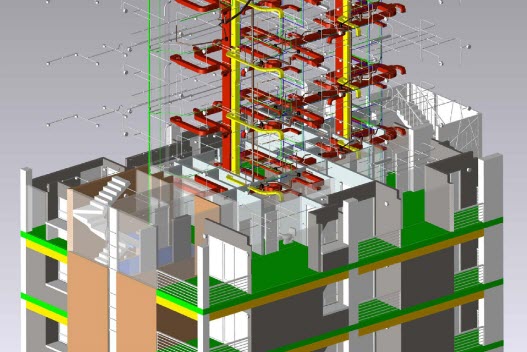
Some BIM-specific use cases included AI-based clash detection, drawing generation, and model optimization.
AI is particularly exciting in its potential to enable more widespread BIM adoption. BIM is inherently data-rich and collaborative, yielding incredible results but demanding specific skills, substantial cost outlays, and detailed data management. Across AEC spaces, these factors, combined with regulatory and awareness challenges, have proved to be a barrier for BIM adoption.
AI offers the potential to reduce these concerns by handling complex, tedious data in an extremely cost-effective way.
Of course, AI adoption in AEC situations is not without barriers. AEC data, particularly in BIM models, can be fragmented or incomplete, severely restricting AI’s effectiveness. Ever-present issues with interoperability create similar limitations.
These challenges have been thorns in the side of the industry for a while, and will likely continue to present a barrier to overcome for developers in this market.
Evolving Government Regulations and External Pressures
Developers and end-users working in AEC spaces are no strangers to the role governmental regulations play in their industry. Understanding the details and impacts of these rules is one of the most important factors for those creating applications to be aware of. We are seeing a clear trend. Governments are no longer simply encouraging digital construction; they're mandating it.
Several regulatory trends are shaping how AEC software must be designed and delivered:
Mandates and Standardization
Many countries are adopting BIM mandates, including those across the EU, UK, United States, Australia, New Zealand, Singapore, and more. These regulations often include pushes towards open standards like IFC, though implementation varies greatly by industry and geographical area. To compete in these countries, developers must prove their applications' compliance with the relevant standards.
Sustainability and Carbon Reporting
While mandates and general standards should inform application development, special attention is being paid to evolving environmental rules. Ever-growing pressure towards environmental sustainability is causing more regulations for BIM models to contain environmental data . This includes material tracing, lifecycle assessment, and broader environmental performance metrics. The required inclusion of this information creates new opportunities for integration with other workflows and data sharing. This is a trend that is likely to continue to shift as climate pressure continues to play a significant role in guiding policy, particularly in the EU.
Digital Twins and Public Infrastructure
Public digital twins are a fascinating development, with places like Singapore, the UK, and the EU developing urban digital twin initiatives to provide strictly structured data to these platforms. They come with strict transparency and data governance regulations, but represent a new world of opportunities for citizens and companies alike to interact with data about the world around them. Similarly, these projects represent opportunities for AEC developers.

Data Sovereignty and Compliance
With AEC data playing a greater role in public and private infrastructure, platforms that are open, transparent, and in control of their information will have a massive advantage. The term data sovereignty is key here: as more rules and transparency are required, developers must have the ability to meet traceability and data hosting regulations, or risk their applications rapidly becoming obsolete.
What Do These Regulations Mean for Software Developers?
While awareness of these rules is vital, developers want to know the nitty-gritty of how this impacts their AEC application development. There are a few key takeaways:
Interoperability is becoming more essential as governments, especially those in Europe, demand flexibility and vendor neutrality
Compliance with openBIM, ISO Standards, and environmental data models creates a massive competitive advantage for AEC applications
Export function demand is increasing, along with structured metadata pipelines, with IFC, BCF, COBie, and DWG being key formats
Looking Ahead: Building Software in an Increasingly Complex AEC Landscape
As AEC continues to evolve, the expectations placed on software continue to rise. Cloud delivery models, AI-driven workflows, and increasing regulatory demands are no longer emerging concepts; they are shaping how modern AEC applications are built and evaluated today.
For developers, the challenge is not simply keeping pace with change, but building software that can adapt as requirements, standards, and user expectations shift. This requires tools and platforms that reduce complexity, support open and interoperable workflows, and make it easier to scale without constant rework.
So, what can you do to get ahead?
For developers looking to get ahead, the next step is understanding what elements make up a successful AEC application. We encourage you to check out our piece on The Building Blocks of AEC Software: A Developer’s Guide for an overview of what you need, what options exist to fulfill those demands, and the next steps.
Spoiler alert: Software Development Kits (SDKs) can be a big piece of the puzzle. From Data Translation and 3D Modeling to Simulation and Graphics, we would love to chat about how toolkits can help serve your unique circumstances. Click here or fill out the form from the button below to get in touch. You can also check out our AEC Webinar, "Building the Future of AEC Software with SDKs", below